
Document governance
The system knows which documents a case must hold, what is missing, what is expiring and who may open it. A folder becomes a dossier with rules.
The document process, end to end
From the document that arrives to the operation carried out in your own business system, DOK Genius drives every process through to the end — with AI that reads the documents and evidence at every step.
Built for document-heavy, compliance-driven teams
The problem
When files, decisions and approvals live across email, drives and disconnected tools, control and accountability disappear — and AI on top of that chaos only amplifies the risk.
Critical files sit in inboxes, shared drives and personal folders — duplicated, outdated and impossible to trust.
Approvals happen over chat and email, with no record of who decided what, when, or why.
AI is only as reliable as the data and processes behind it. Ungoverned content produces ungoverned answers.
The platform
Some teams need to get their documents under control. Others need to drive a process from start to conclusion. DOK Genius serves both — and compliance and AI belong to both, not to one.
The system knows which documents a case must hold, what is missing, what is expiring and who may open it. A folder becomes a dossier with rules.
Each case follows a defined path: it moves on only when the conditions are met, only those with authority decide, and it concludes by calling the business system that owns the operation.
Evidence written at the moment each thing happens — who decided, what was sent, what came back. Not a report assembled afterwards from memory.
It reads what arrives, pulls out the data the process needs, and answers questions about the dossier citing where each answer came from — within each user's permissions.
Product tour
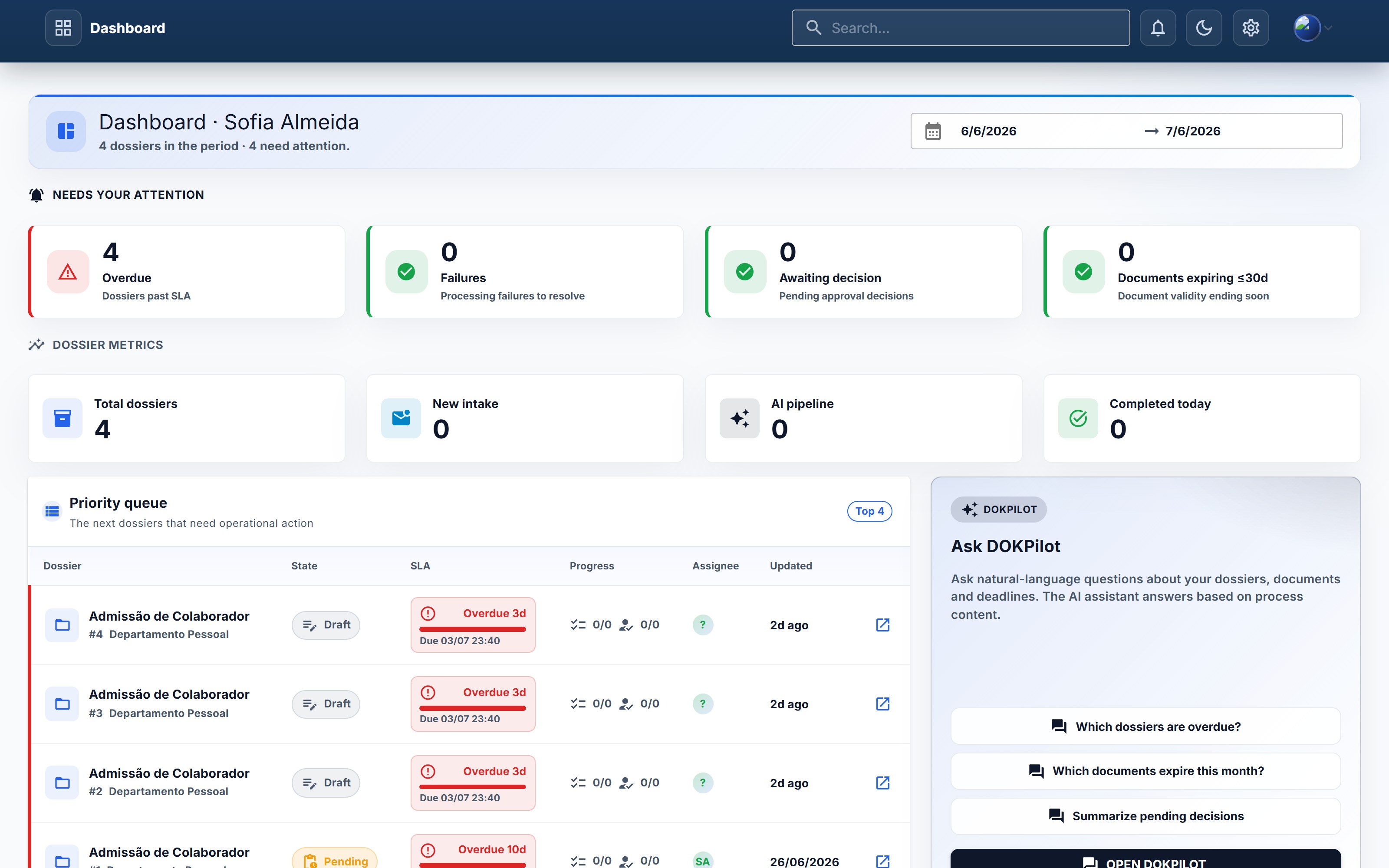
Real screens from the product — exactly what your team will work with, from the guided dossier to AI answers.


Document governance
Document governance means your files don't just sit in storage — the system knows which process they belong to, what each case should contain and who is allowed to see them. That much works today. Here is what it already does, and how far the idea goes.
Two views of the same model — one to configure it, one to use it.
The Required Documents an architect defines are materialized into each Dossier as the Documents a contributor fills with attachments.
Each process declares the documents a case must hold. The dossier shows what is complete, what is missing and what is expiring, points at the next action, and refuses submission while a mandatory document is absent.
Version history per document, retention and disposal policies, and formal signature — the deeper layers, for the moment a customer's regulator asks for them.
Instead of answering when someone asks, the system keeps watch: deadlines per stage, cases sitting still, documents about to expire — raised before they become the problem.
Autonomous operations
Filing a document well is worth little if somebody still has to retype it into another system. These four steps carry a document from arrival to the operation itself, running on their own with nothing retyped in between — and stopping wherever the process says they should, because the rules and the approvals are yours.
It arrives by e-mail, through the intake API or from a scanner, is read and classified, and opens the right dossier by itself. When the match is not clear enough, it waits for a person instead of guessing.
Required documents, deadlines, extracted data, validations and approvals move the work forward. What is missing is visible; what is complete is ready.
The dossier calls the system that owns the operation — issuing the policy, opening the claim, registering the order — with the data it gathered and no retyping. On a process set up to run autonomously the call goes out on its own, once the approvals and the quality review that process requires have been given.
The result comes back from that system and closes the case, carrying its reference. Nothing is marked done on an assumption.
DOK Genius does not replace the system that owns your business operation. It runs the document process around it and hands over exactly what that system needs.
Platform
A complete set of building blocks for governed, end-to-end document operations.
Group related document processes into reusable packages aligned to how your business actually works.
Templates that drive each case: fields, checklists, approvers, org-unit scope and AI search config.
Cases with a controlled lifecycle — clear states, owners, and state changes recorded with actor, reason and date.
Capture the exact data each process needs with configurable, validated fields.
Sequential or parallel human approvals with comments, rejections, reopens and decisions on record.
An AI assistant to search, summarize and analyze documents — within permissions and tenant scope.
Text extraction, classification, embeddings and semantic search powered by pgvector.
Changes, decisions and sign-ins recorded with author, timestamp and context — available for internal review and traceability.
Granular control by tenant, role and confidentiality level across every document and case.
Name who works on a dossier and who only follows it — collaborators and watchers, per case, without widening anyone's access elsewhere.
Filter dossiers by process, configurable fields, document condition and validity — then save the search and share it with your unit.
Documents carry a validity date; what has lapsed and what is about to lapse is shown apart, with advance notice set per process.
Genius
Genius turns governed content into operational knowledge — answering with context, sources and traceability, always inside the user's permissions and tenant.
Find the right information even when the question doesn't match the document's exact words.
Every response cites its origin so humans can validate before acting.
Results respect each user's effective access and tenant scope.
Security & compliance
Isolation, permissions and an audit trail give you verifiable control over sensitive information.
Data and configuration fully separated per organization.
Access controlled by responsibility and context.
Clear handling for sensitive and restricted content.
Action history available for internal review and traceability.
Use cases
Teams across regulated and process-driven industries rely on DOK Genius to keep documents and decisions under control.
Govern claims, policy files and supporting evidence with auditable approvals and AI-assisted review.
Claims & policiesCentralize contracts and matters with controlled access, approvals and decision history.
Contracts & mattersMaintain evidence, enforce policies and prepare for audits with traceability by design.
Audit-readyStandardize document requests, checklists and validations across high-volume processes.
High volumeRun repeatable document workflows with clear ownership, states and SLAs.
WorkflowsReplace scattered drives with a governed system of record for critical documents.
System of recordPricing
Start free on Cloud Free, up to 2 users. When your team grows, you pay per user and choose your organization's storage.
Get started
Start with one process that matters. Watch it run from the document arriving to the operation carried out — and see what it leaves behind as evidence.